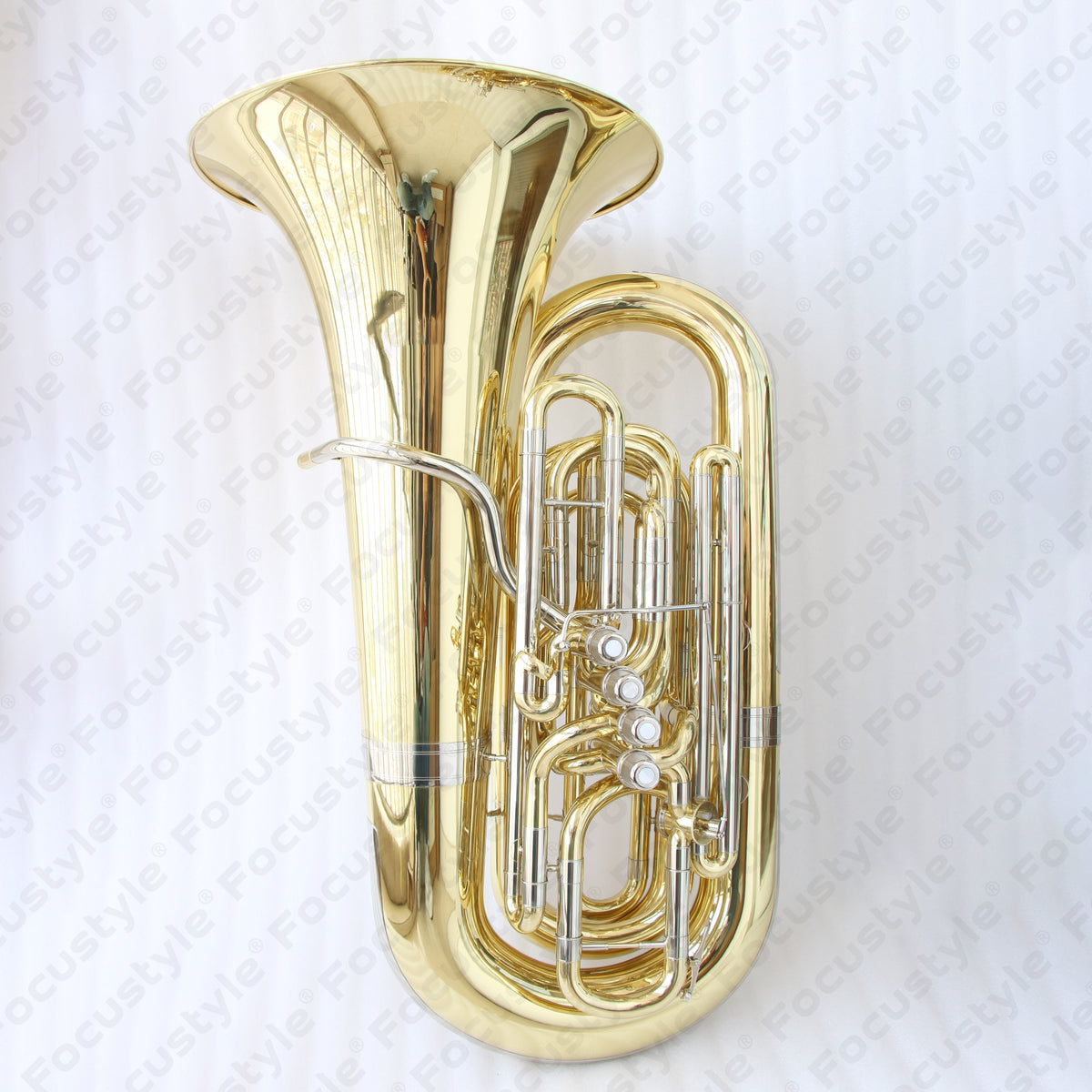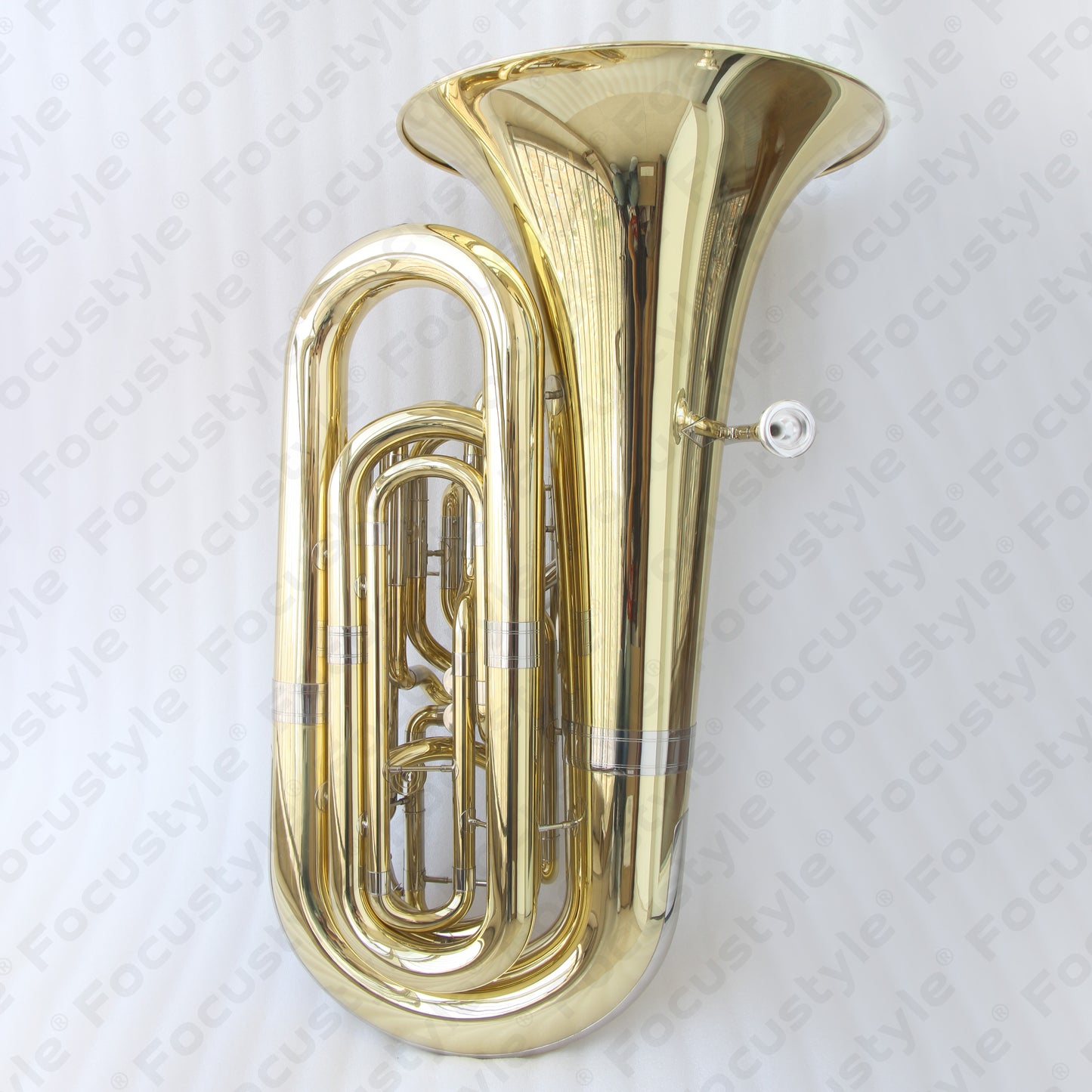


Focustyle Studio FTU-800 BBb Tuba
Regular price
$3,799.00 USD
Regular price
$3,999.00 USD
Sale price
$3,799.00 USD
Taxes included.
Shipping calculated at checkout.
Click "shipping" to view our shipping policy
Need expedited shipping? GET A QUOTE
Products not marked as in stock are made to order,typically taking 2-4 weeks.
Quantity
Couldn't load pickup availability
- 5/4 size compact
- 470mm (18.5") bell made of yellow brass
- 21.2mm (0.835") Bore
- 930 mm(36.5”) Height
- 4 front action pistons
- 5th rotary valve
- Nickel silver leadpipe
- Nickel inner and outer slides
The Function of the 5th Rotary Valve on a Tuba
On professional orchestral tubas (especially BBb or CC tubas), the 5th rotary valve is a crucial, high-end feature. Its presence is primarily designed to resolve inherent intonation deficiencies in the extreme low register and to expand the instrument's overall range. Its benefits can be broken down into three core dimensions:
- Automatic Low-Register Pitch Correction (Intonational Compensation): Due to the acoustic laws of brass instruments, when a player presses multiple pistons simultaneously (such as 1+2+3) to play in the extreme low register, the combined tubing length is slightly shorter than theoretically required. As a result, notes in the extreme low register tend to go sharp. The 5th valve engages an additional branch of tubing (usually a whole step or a half step in length). Activating it instantly elongates the tube, bringing the sharp pitch down to perfect intonation without forcing the player to lip the note down lip-fatiguingly via embocadura adjustments.
- Filling the Low-Register "Range Gap" (Eliminating the Blind Spot): A standard 4-piston tuba has a gap of about a half-octave between the pedal tones (fundamental register) and the first overtone, where certain semitones cannot be played chromatically or are extremely difficult to slot. With the extra tubing added by the 5th rotor, it can be combined with the first 4 pistons to completely bridge this gap. This grants the tuba seamless, full chromatic capability in the lowest frequencies, which is indispensable for modern orchestral literature.
- Providing More Efficient Alternative Fingerings: In fast-moving passages or large interval leaps typical of contemporary music, traditional 4-piston combinations can be clunky and awkward. The 5th rotor provides a completely new set of alternative fingerings. Low notes that would normally require three fingers at once can often be played much more fluidly by combining the "5th rotor + 1 piston," significantly enhancing technical agility.